If You Haven't Got Time to Work Your Leads, You're Paying to Be Ignored
By Tom McEwan · 18 July 2026
Here's an uncomfortable truth about paid advertising: the ads are usually not the problem.
We see it constantly. A business pays for advertising, the leads come in, and then those leads sit unanswered for hours — sometimes days — because the owner was on a job, in a meeting, or simply didn't see them. By the time anyone rings back, the person who enquired has either forgotten they filled the form in, lost interest, or booked someone else.
At that point it doesn't matter how good the ads were. Every lead you don't work properly is money you've already spent, walking out of the door.
The good news is that working leads well isn't complicated. It's a handful of habits — or better still, a system that does the habits for you. Here's the whole thing: what a lead actually is, where it should land, when to make contact, how to run the conversation, and what to realistically expect.
What a lead actually is (and isn't)
A lead from a Facebook or Instagram ad is someone who saw your ad, tapped it, and filled in a form with their name and number asking to hear from you. That's a genuinely warm enquiry — they raised their hand.
But here's what a lead isn't: a sale. They haven't committed to anything. They filled in a form on their phone in about fifteen seconds, probably while doing something else, and the moment they put the phone down your business starts fading from their memory. A lead is interest with a shelf life. Treat it like a customer and you'll lose it. Treat it like a live enquiry that needs a fast, human response, and a healthy share of them become customers.
This is the mindset shift that changes everything: leads aren't good or bad on arrival. They become good or bad depending on what happens next.
Where your leads should land
If your leads live inside Facebook's Leads Centre, you have a problem, because nobody checks Facebook's Leads Centre. Facebook doesn't even notify you properly when a new lead arrives — and it deletes lead data after 90 days.
Leads need to land where you already look: your phone. Every lead, the second it's submitted, should trigger an instant alert with the person's name, number and what they asked about — no logging in, no downloading spreadsheets, no "I'll check later."
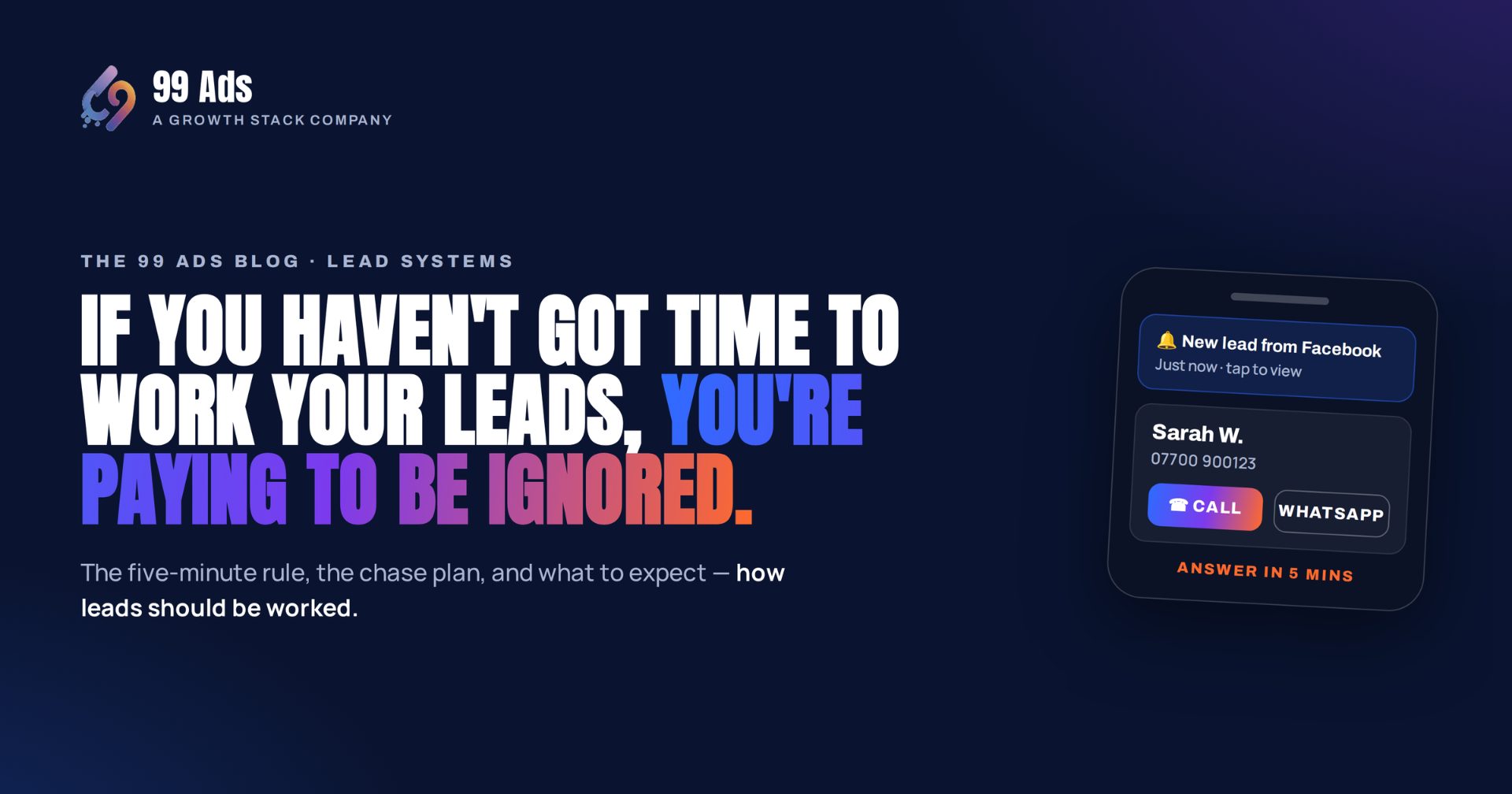
We set our clients up with Privyr, a mobile app that connects directly to their lead forms. A lead fills in the form, the phone pings, and one tap shows everything — with a call button and a pre-written intro message ready to send. No system for receiving leads means no system for converting them. This is the foundation everything else sits on.
When to make contact: the five-minute rule
This is the single most important thing on this page.
Something must reach a new lead within five minutes. No exceptions.
Think about it from their side. They've just tapped your ad — they're literally holding their phone, thinking about the thing they enquired about. Ring them in that window and you're catching them at the exact moment of peak interest. Ring them tomorrow and you're a stranger interrupting their day about something they half-remember.
Can't take a call because you're mid-job, mid-meeting, mid-life? Fine — but something still goes out inside five minutes. A short text or WhatsApp does the job: "Hi [name], thanks for your enquiry — I'll give you a ring shortly." That one message parks the lead safely. They know you've seen them, they know you're coming, and they're far less likely to keep shopping around in the meantime.
This is also exactly where a system earns its keep. With a template saved in your lead app, that message goes out in one tap with their name already filled in. Set up properly, it can even go out automatically — so the five-minute rule holds even when you physically can't.
How to work a lead: the chase plan and the call
One call is not working a lead. Most enquiries are won on the third to sixth attempt — and most businesses give up after one. That gap is where the money is.
Here's the cadence we give every client:
- Day 1: call within five minutes; text if no answer; call again that evening.
- Day 2: call at a different time of day; text if no answer.
- Day 3: final call; then a close-out text.
Six touches over three days, then stop. It's persistent without being a pest, and it wins the leads everyone else lets go cold.
When they do answer, keep the call simple. You're not selling — you're qualifying and booking. Three questions do it: What do you need? What's the situation at the moment? When do you want to get started? Then book the next step before you hang up — a visit, a quote, a proper call in the diary. Don't quote on the spot and don't leave it at "I'll send some info over." A firm date is the win.
And the close-out text for leads who never picked up? "Tried you a few times about your enquiry — if it's still on the cards, just reply YES and I'll ring you." You'd be surprised how many YES replies that one message pulls back from the dead.
What to expect (honestly)
Set your expectations right and lead generation stops being frustrating.
Not every lead will answer. Some filled the form in on a whim, some went quiet, some were never serious. That's normal — it's true for every business running ads, including businesses spending a hundred times what you do. The question is never "were all the leads good?" It's "did I give every lead a proper chance to become a customer?" Six touches over three days is a proper chance. One missed call at 9pm is not.
Expect the wins to come from the follow-up, not the first dial. Expect some weeks to be better than others. And expect dead leads — but don't expect them to be worthless. A lead that went quiet this month isn't gone; the timing was wrong. Kept in your own ad account, those dead leads become a re-marketing audience — people who already knew you once, who can be put back in front of your offers later in the year for a fraction of the cost of finding them the first time. Nothing gets thrown away.
If you haven't got time for any of this
Then be honest with yourself, because this is the crossroads.
Option one: keep paying for leads and keep half-working them. That's the most expensive option on this page, because you carry the full cost of the ads and collect a fraction of the return.
Option two: build the system. Instant lead alerts to your phone, saved message templates, an automatic first-response text, a follow-up cadence with reminders, and a re-marketing pot for the leads that go quiet. None of it requires you to find more hours — it requires the first five minutes to be handled by something other than your memory.
That system is what we set up for every 99 Ads client on day one, alongside the ads themselves — and like everything we build, it's registered in your name and it's yours to keep. We even wrote the whole thing up as a one-page playbook our clients keep by the phone.