Your best ad probably isn't getting the money
By Tom McEwan · 8 August 2026
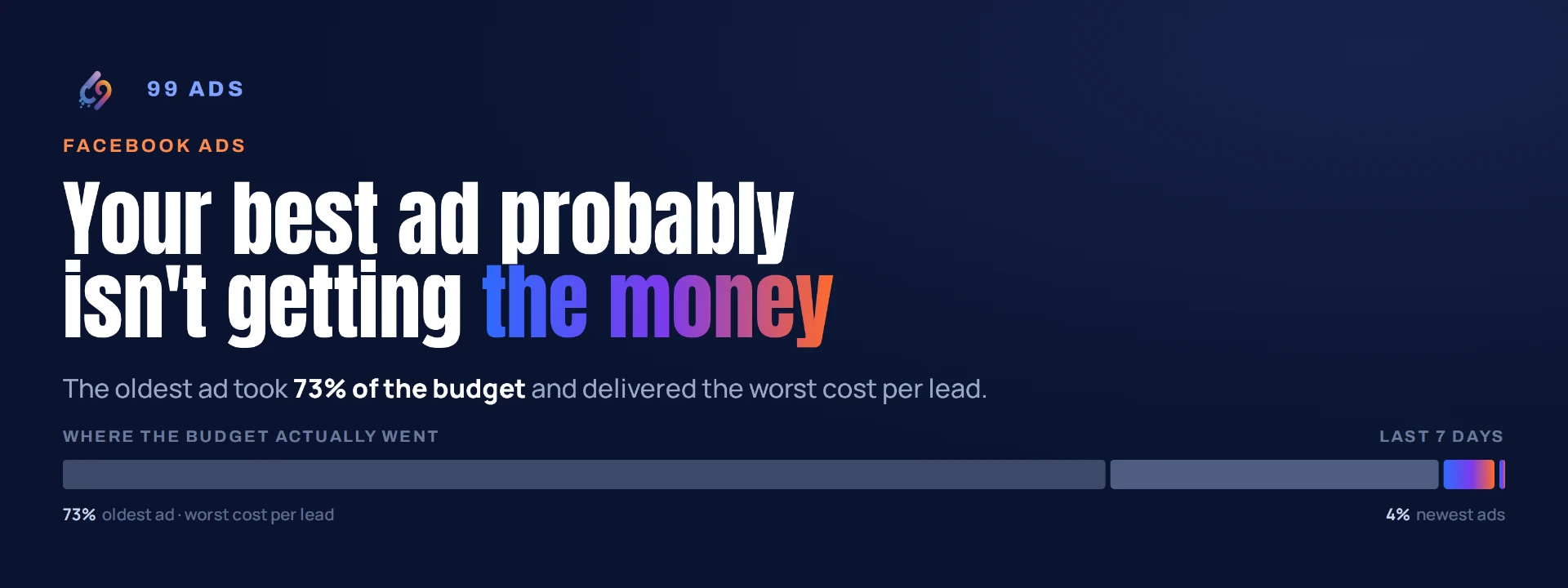
I pulled the last seven days out of my own ad account this week and found something that annoyed me.
Four ads running. Same campaign, same budget, all competing for the same pot. Here's how the money actually got shared out:
| Ad | Spend | Share of budget | Leads | Cost per lead |
|---|---|---|---|---|
| The old one | £56.83 | 73% | 5 | £11.37 |
| Second oldest | £17.81 | 23% | 2 | £8.90 |
| New ad | £2.89 | 4% | 1 | £2.89 |
| Newest ad | £0.29 | 0.4% | 0 | — |
The oldest ad took nearly three-quarters of the budget and delivered the worst cost per lead of anything that got a proper run.
Meanwhile a new ad got less than three quid and produced a lead at £2.89.
Why this happens
When you've got several ads running in the same ad set, Facebook decides between them. It doesn't split the money evenly. It backs whichever one it thinks will do best — and it works that out largely from history.
An ad that's been running for weeks has history. It's had thousands of impressions, it's got engagement, Facebook has a confident prediction about what it'll do next.
A brand new ad has none of that. Facebook has no idea whether it's any good, so it doesn't risk much on it.
Which is reasonable, in a way. But it produces an outcome that isn't:
Your incumbent ad wins on seniority, not on merit.
And once it's winning, it keeps winning, because every pound it spends adds more history and makes it look like even more of a safe bet. New ads get starved before they ever get a fair test.
The number that actually mattered
Cost per lead was telling me the wrong story, because the new ads had barely spent anything. One lead from £2.89 is a fluke, not a result.
So I looked at how many impressions each ad needed to produce a lead. That works at low spend because impressions add up much faster than leads.
- New ad: 1 lead per 163 impressions — 0.61%
- Second oldest: 2 leads per 653 impressions — 0.31%
- Old ad: 5 leads per 3,756 impressions — 0.13%
The new ad was converting roughly four and a half times better per impression than the one taking three-quarters of the budget.
It just never got enough money to prove it.
The mistake I'd already made
Here's the bit I got wrong, and it's the common one.
When I added the new ads, I left the old ones running. It felt sensible — don't turn off something that works, let them compete, may the best ad win.
Except they weren't competing. The old ad had a head start it could never lose, and I'd effectively rigged the test before it began.
Worse, my daily budget was fairly modest. Split four ways, none of them had enough to produce a clear result. Facebook needs a decent run of conversions on each ad to tell them apart. Give it four ads and eight leads a week and it can't distinguish between them — so it falls back on what it already knows, which is the old ad.
Too many ads on too small a budget isn't a test. It's noise with a spreadsheet attached.
What to do instead
Run two ads at a time. Not five. Two gets a meaningful share of budget each. Five gets you five underfunded ads and no conclusion. If you're on a small daily budget, two is genuinely the maximum.
Turn the old one off when you're testing something new. This feels wrong and it isn't. If the new ad is worse, you'll know inside a week and you can switch the old one back on. If it's better, you've found that out instead of subsidising the incumbent for another month.
Judge by impressions early on, not cost per lead. Cost per lead needs volume before it means anything. Impressions to conversion tells you something useful much sooner.
Then leave it alone for a week. Every change resets Facebook's learning. If you keep adjusting, you never get a clean read on anything.
Why any of this matters
If you're spending £20 or £30 a day, this is the difference between roughly two enquiries a day and roughly five — on identical spend, with ads you already have.
It's not a targeting problem. It's not a budget problem. It's the way the budget is being shared out between things you're already paying for.
And unless you go and look at the split, you'll never see it. The account will just look like it's ticking along, because the total spend is right and leads are coming in. They're coming in from the wrong ad, at nearly four times the cost.
And before you touch anything — if the account has gone quiet rather than expensive, check the billing before you change anything.
Worth checking: open your ad account, set the date range to the last seven days, and look at what each individual ad spent — not what the campaign spent.
If one ad has most of the money and it's not your best performer, you've got the same problem I had.
I'll go through your account properly and tell you exactly what's working and what's quietly wasting money. Fixed price, £299, and every finding is yours to keep whether you work with me afterwards or not.
Book an audit